
Preloader Close
Close

Keep up to date on the latest economic and financial trends, what's going on in the community, and Progress Group Inc. updates.
- 80 Atlantic Ave 4th Floor, Toronto, ON M6K 1X9 Suite 420
- GET IN TOUCH (289) 813-3378

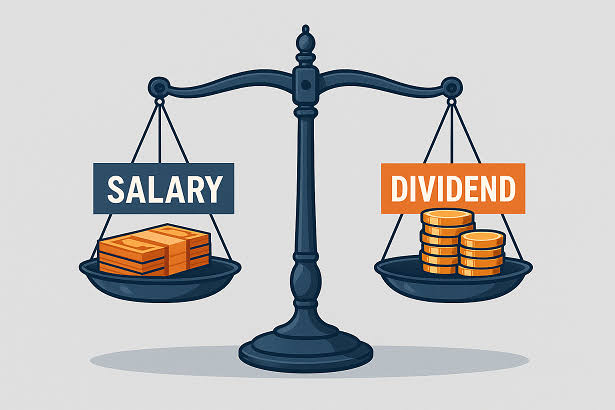
Salary vs Dividends: How Incorporated Business Owners in Canada Should Pay Themselves
 Uncategorized
Every incorporated business owner in Canada eventually asks the same question.
Should I pay myself a salary or a dividend?
It sounds like a simple choice between two options.
It is not.
It is a decision that touches corporate tax, personal tax, payroll compliance, retirement savings, mortgage qualification, CPP entitlement, and the long term structure of your wealth.
Most business owners answer it once, usually in their first year of incorporation, and then never revisit it.
That is the expensive part.
The right compensation mix changes as your income changes, as your corporation accumulates retained earnings, as tax rates move, and as your personal goals shift.
A structure that was correct three years ago may be actively costing you money today.
This guide explains how salary and dividends actually work in Canada, where each one wins, why the answer is almost never one or the other, and what an incorporated business owner should be reviewing every single year.
The Question Behind the Question
Business owners usually frame the decision as a tax question.
It is broader than that.
When you decide how to pay yourself, you are simultaneously deciding:
- How much tax your corporation pays
- How much tax you pay personally
- Whether you build RRSP contribution room
- Whether you contribute to and accrue CPP
- Whether you carry payroll obligations and remittance deadlines
- Whether a lender will treat your income as qualifying income
- How much capital stays inside the corporation to be invested
- How exposed you are to future changes in tax law
Each of those consequences has a cost and a benefit.
Optimizing for tax alone frequently produces a worse overall outcome.
What Is a Salary?
A salary is employment income paid by the corporation to you as an employee.
From the corporation’s perspective, salary is a deductible expense. It reduces corporate taxable income dollar for dollar.
From your perspective, salary is taxable as employment income at your personal marginal rate.
Paying salary requires the corporation to:
- Register a payroll account with the Canada Revenue Agency
- Withhold income tax at source
- Withhold and match CPP contributions
- Remit those amounts on a set schedule
- Issue a T4 slip each year
- File a T4 summary by the annual deadline
Salary is administratively heavier than a dividend. That administrative weight is the price of the benefits it generates.
What Is a Dividend?
A dividend is a distribution of corporate profit to you as a shareholder.
Dividends are paid out of income the corporation has already been taxed on. The corporation receives no deduction for paying them.
From your perspective, a dividend is taxed under the gross up and dividend tax credit mechanism, which is designed to give you credit for the tax the corporation already paid.
Paying dividends requires the corporation to:
- Declare the dividend by director resolution
- Issue a T5 slip
- File the T5 summary by the annual deadline
There is no payroll account, no source withholding, and no CPP.
That simplicity is genuinely attractive. It is also the reason dividends are frequently over used.
The Principle of Integration
Canadian tax law is built around a concept called integration.
The theory is that a dollar earned inside a corporation and then distributed to a shareholder should attract roughly the same total tax as a dollar earned personally.
In theory, the salary versus dividend decision should therefore be close to neutral.
In practice it is not neutral, for three reasons.
First, integration is approximate rather than exact, and the degree of imperfection varies by province and by the type of income.
Second, the two routes produce completely different non tax outcomes.
Third, timing matters. Salary is taxed in the year paid. Retained corporate earnings can be distributed later, in a year when your personal income is lower.
Integration explains why the decision is close.
It does not explain what to do.
Where Salary Wins
There are situations where salary is clearly the stronger choice.
Building RRSP Contribution Room
Only earned income creates RRSP room. Dividends do not.
RRSP room accrues at 18 percent of the prior year’s earned income, subject to the annual dollar limit. For 2026 that dollar limit is $33,810.
A business owner who pays themselves exclusively in dividends builds no RRSP room at all. Over a twenty year career, that is a substantial amount of tax sheltered growth given up.
Reducing Corporate Income Below the Small Business Limit
The small business deduction applies to the first $500,000 of active business income earned by a Canadian controlled private corporation.
Income above that limit is taxed at the general corporate rate, which in Ontario is 26.5 percent combined.
Salary is deductible. A well timed bonus or salary can bring corporate income back under the threshold and prevent profit being taxed at the higher general rate.
Qualifying for Financing
Lenders underwrite against documented, verifiable income.
A T4 is the cleanest evidence of personal income a mortgage lender can receive. Business owners who pay themselves entirely in dividends routinely find their borrowing capacity is materially lower than their actual economic income would suggest.
If you intend to buy property, refinance, or expand a real estate portfolio in the next two to three years, that consideration should be built into your compensation plan well in advance.
Accessing Personal Deductions and Credits That Require Earned Income
Certain personal tax positions depend on earned income. Childcare expense deductions are the most common example.
Individual Pension Plans and Other Registered Structures
Advanced retirement structures available to incorporated owners generally require T4 income to support them.
Where Dividends Win
Dividends also have clear advantages.
Avoiding CPP Cost
CPP is a significant, and frequently underestimated, cost of paying salary.
For 2026, the year’s maximum pensionable earnings is $74,600 and the contribution rate is 5.95 percent for both the employee and the employer, producing a maximum contribution of $4,230.45 on each side.
A second tier, CPP2, applies to earnings between $74,600 and $85,000 at 4 percent, adding a maximum of $416 on each side.
Because your corporation pays the employer portion, an owner manager effectively funds both halves. At maximum earnings that is roughly $9,300 per year leaving the corporation before a single dollar of income tax is considered.
Whether that is a cost or an investment depends entirely on how you value the future CPP benefit. It is a genuine benefit, indexed and payable for life. It is not simply a tax.
But it is a real cash outflow, and it should be a conscious decision rather than an accident.
Administrative Simplicity
No payroll account. No source deductions. No remittance schedule. No late remittance penalties.
For a small corporation with a single shareholder, that simplicity has real value.
Timing Flexibility
Salary generally needs to be paid and remitted as it is earned.
Dividends can be declared when it suits the shareholder, which allows income to be shifted into lower income years.
Distributing to Other Shareholders
Where a corporate structure legitimately includes other shareholders, dividends can be a mechanism for distributing income. This area is heavily governed by the tax on split income rules and requires specific professional advice. It is not a strategy to implement informally.
The Blended Approach
In practice, most well advised incorporated business owners do not choose one or the other.
They use both.
A common structure looks like this:
- Enough salary to generate the RRSP room the owner wants
- Enough salary to keep corporate income at the intended level relative to the small business limit
- Enough salary to support financing requirements
- Dividends for the remainder of the required personal cash flow
- Retained earnings left in the corporation where the owner does not need the money personally
The specific numbers are different for every business owner.
The framework is the same.
What Changed in 2026
Compensation planning is not static, and 2026 delivered a meaningful change for Ontario corporations.
Effective 1 July 2026, Ontario reduced its small business corporate income tax rate from 3.2 percent to 2.2 percent. Combined with the federal small business rate of 9 percent, the combined rate on the first $500,000 of active business income falls from 12.2 percent to 11.2 percent.
For corporations with a tax year straddling 1 July 2026, the rate is prorated based on the number of days before and after that date. A corporation with a 31 December 2026 year end will pay a blended combined rate of approximately 11.7 percent for the year.
The practical effect is that leaving profit inside the corporation became slightly more attractive than it was in 2025.
The gap between the corporate small business rate and the top personal marginal rate in Ontario, which exceeds 53 percent, is now wider than 42 percentage points.
That gap is the deferral advantage. It is not a permanent tax saving. The tax is paid eventually, when the money comes out. But the ability to invest pre distribution dollars for years or decades is one of the most powerful advantages incorporation offers.
Every business owner in Ontario should have their compensation mix re run against the new rate before their 2026 year end.
The Passive Income Trap
There is a limit to how much profit should be retained.
When a corporation and its associated group earn more than $50,000 of adjusted aggregate investment income in a year, the federal small business limit is reduced by $5 for every $1 of investment income above that threshold. The federal small business deduction is eliminated entirely once investment income reaches $150,000.
This matters enormously for business owners who have been retaining earnings for years and investing them inside the corporation.
The strategy that saved tax in year one can quietly begin costing tax in year eight.
Adjusted aggregate investment income is calculated on the prior year, which means the damage is done before you see it on a return.
This is one of the strongest arguments for reviewing compensation annually rather than setting it once.
Common Mistakes Business Owners Make
Deciding Once and Never Revisiting
The single most common error. A structure set in the first year of incorporation is rarely still optimal in year five.
Taking Shareholder Draws Without Documentation
Money taken out of the corporation without being characterized as salary, dividend, or repayment of a shareholder loan creates a shareholder loan balance.
If that balance is not repaid within the required timeframe, it can be included in personal income. This is one of the most frequently assessed issues in owner managed corporations.
Ignoring Instalment Requirements
Dividend heavy compensation often produces a large personal tax balance with no source deductions applied against it. That triggers personal instalment obligations, and missing them triggers interest.
Optimizing for This Year Only
The lowest tax outcome in a single year is frequently not the lowest tax outcome across a decade.
Making the Decision Without Current Bookkeeping
You cannot plan compensation without knowing the corporation’s actual profit, its retained earnings, and its investment income.
If the books are six months behind, the planning conversation cannot happen. This is the point at which bookkeeping stops being an administrative task and becomes a strategic one.
What the Decision Actually Requires
A properly considered compensation plan needs:
- Current, reconciled corporate financial statements
- A projection of corporate active business income for the year
- The corporation’s adjusted aggregate investment income position
- Your personal income from all other sources
- Your RRSP and TFSA contribution room
- Your financing plans for the next three years
- Your retirement income expectations
- The shareholder structure and any associated corporations
Any adviser who answers the salary versus dividend question without those inputs is guessing.
The Progress Group Approach
At Progress Group, compensation planning is not a year end conversation.
It is a coordinated decision that draws on corporate accounting, personal tax, financial planning, and, where relevant, mortgage and insurance strategy.
That coordination is the point. In most firms, your accountant sets the salary, your mortgage broker discovers eighteen months later that your documented income is too low, and nobody connects the two.
We support incorporated business owners across Toronto and throughout Canada with:
- Owner compensation planning
- Corporate tax planning and preparation
- Personal tax planning and preparation
- Payroll administration and T4 preparation
- Dividend documentation and T5 filing
- Shareholder loan monitoring
- Retained earnings and passive income analysis
- Financial reporting and bookkeeping
- Retirement and financial planning
- Coordinated mortgage and financing strategy
Our objective is straightforward.
We want every dollar that leaves your corporation to leave it in the most efficient form available, and we want that decision reviewed every year rather than inherited from a conversation you had when you incorporated.
Is it better to pay yourself salary or dividends in Canada?
Neither is universally better. Salary creates RRSP room, supports financing applications, and reduces corporate taxable income. Dividends avoid CPP contributions and payroll administration. Most well structured owner compensation plans use a combination of both, weighted according to the owner’s income level, retirement goals, and financing needs.
Do dividends create RRSP contribution room?
No. Only earned income, which includes salary and bonus, creates RRSP contribution room. Business owners who pay themselves exclusively in dividends accumulate no new RRSP room.
Do I have to pay CPP if I take dividends?
No. Dividends are not pensionable earnings, so no CPP contributions are required or accrued. This reduces immediate cost but also means no CPP retirement benefit is being built.
Can I change how I pay myself from year to year?
Yes. Compensation should be reviewed annually against the corporation’s profit, your personal income, and your goals. Changing the mix from one year to the next is normal and expected.
What is a shareholder loan and why does it matter?
When money is withdrawn from a corporation without being recorded as salary, dividend, or expense reimbursement, it creates a shareholder loan balance. If it is not repaid within the required timeframe, the amount can be added to your personal income. Accurate bookkeeping is what prevents this.
How does the Ontario small business tax rate change affect me?
Effective 1 July 2026, the combined federal and Ontario small business rate on the first $500,000 of active business income fell from 12.2 percent to 11.2 percent. This slightly increases the benefit of retaining profit inside the corporation and is a reason to review your compensation mix before your 2026 year end.
Can Progress Group help with owner compensation planning?
Yes. Progress Group provides coordinated corporate tax, personal tax, payroll, bookkeeping, financial planning, and advisory services for incorporated business owners across Toronto and Canada.


